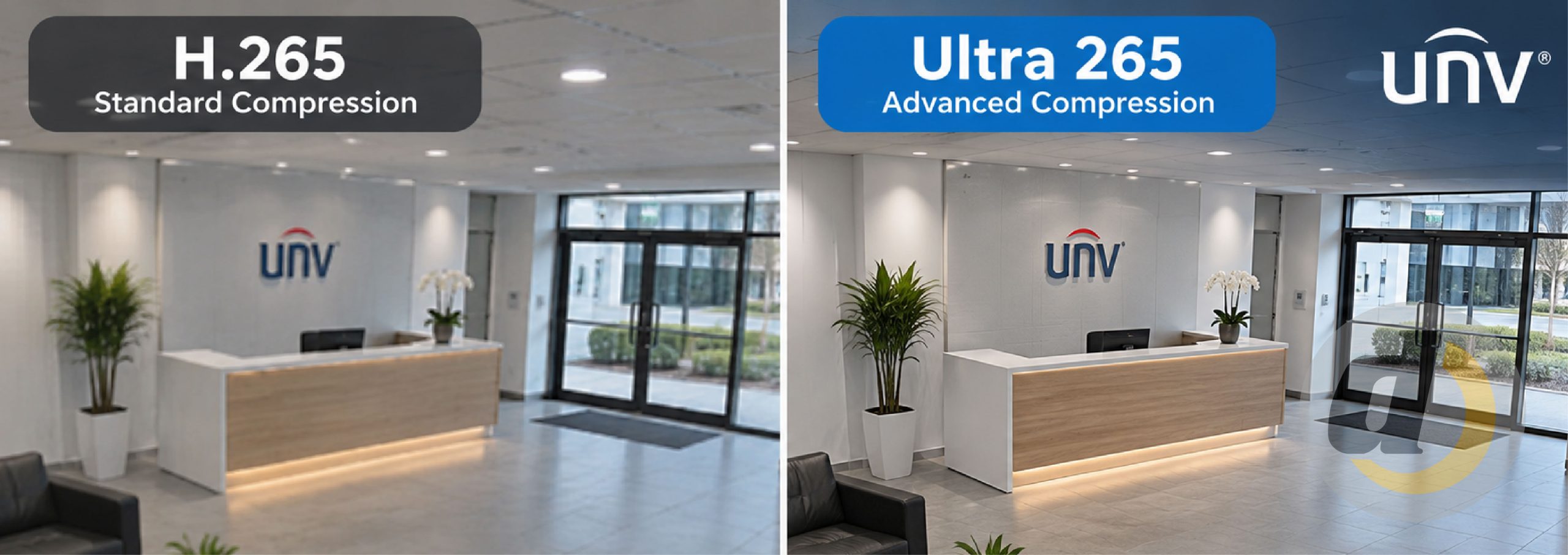
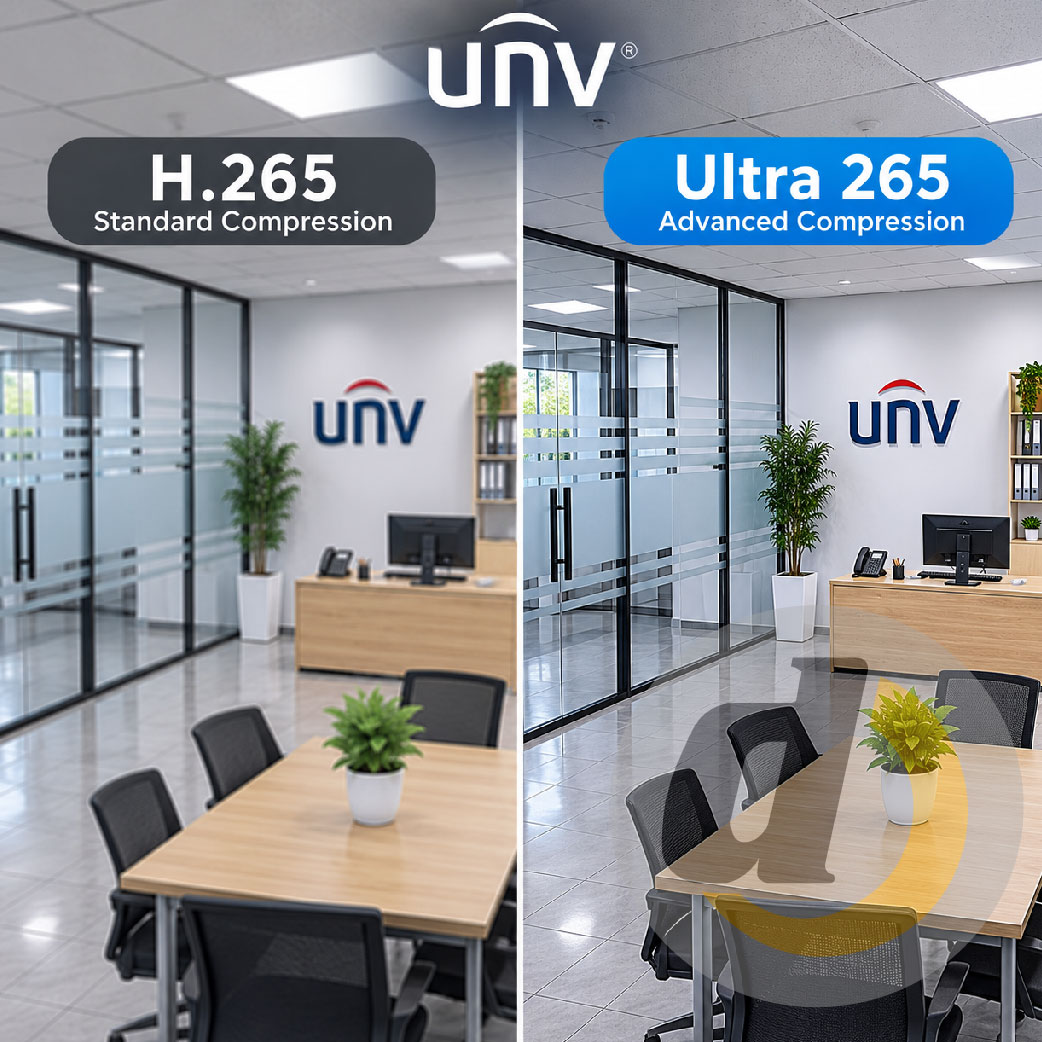
Ultra 265 UNV is Uniview’s (UNV) proprietary, high-efficiency video encoding and compression technology designed specifically for IP video surveillance networks.It pairs standard H.265 (HEVC) video compression with UNV’s patented U-Code smart encoding technique.
KEY CORE CONCEPTS OF ULTRA 265
Combination of H.265 + U-Code
While standard H.265 reduces bandwidth and storage requirements by roughly 50% compared to legacy H.264, Ultra 265 applies U-Code on top of the HEVC baseline.
U-Code analyzes live video streams in real-time, differentiating stationary background elements (like buildings, roads, or static interior walls) from dynamic moving objects (such as vehicles or pedestrians).
Smart Region of Interest (ROI) & Dynamic Frame Rates
Background Suppression: Static areas are compressed heavily using lower bitrate allocations.
Target Retention: Moving targets and critical detail areas (faces, license plates, active zones) retain high bitrate settings to maintain image clarity.
Dynamic GOP (Group of Pictures): It adjusts the frequency of keyframes (I-frames) depending on motion intensity in the frame, reducing redundant data during periods of low or zero activity.
Enhanced Frame (EF) Technology
Squeezes unnecessary data frames during idle periods while dynamically inserting reference frames when motion or events occur, preventing image blur and artifacts.
PRIMARY BENEFITS
Up to 95% Storage Reduction
Compared to standard H.264 streams, Ultra 265 can reduce overall storage consumption by up to 95% (and up to 70–75% lower storage requirements compared to standard H.265).
Significant Bandwidth Savings
Drastically lowers network load, making high-resolution feeds (4K / 8MP, multi-sensor cameras) easier to stream over limited bandwidth connections or local area networks.
Hardware & Cost Efficiency
Reduces the number of hard drives needed inside Network Video Recorders (NVRs) for long-term retention goals, lowering initial deployment and ongoing operational costs.
Preserves Video Analytics Quality
Unlike destructive compression techniques that degrade image clarity, Ultra 265 preserves target sharpness, maintaining high accuracy for VCA (Video Content Analysis) and AI analytics such as Smart Intrusion Prevention (SIP).
IN WHICH SCENARIO IS BETTER TO USE ULTRA 265 TECHNOLOGY?
UNV security cameras with Ultra 265 technology works by suppressing static background data while dynamically maintaining high image detail during motion events, it is most effective in environments where storage costs, bandwidth constraints, high-resolution requirements, or extended retention periods present operational challenges.
High-resolution streams (such as 4K or 8MP IP cameras) consume massive bitrates (often 8–12 Mbps per stream on legacy codecs).
Ultra 265 drops the stream bitrate significantly, allowing facilities to deploy dense camera counts (e.g., 32+ 4K cameras) over standard network switches and NVR hardware without overwhelming backplane bandwidth.
Remote, Wireless, and Cellular Site Monitoring
LTE/Cellular Gateways: Deployments relying on 4G/5G mobile routers (construction sites, solar farms, utility stations) have strict data caps or high per-gigabyte costs.
Point-to-Point (P2P) Wireless Bridges: Remote sites connected via wireless radios benefit from reduced network congestion and lower packet loss.
Strict Compliance & Long-Term Video Retention Requirements
Certain industries demand 30, 60, or 90+ days of continuous video retention (e.g., banks, casinos, healthcare facilities, government sites).
Using Ultra 265 cuts total disk count requirements by up to 75%, drastically lowering the total cost of ownership (TCO) for NVRs, SAN/NAS storage, and hard drive hardware.
Multi-Site & Centralized VMS Management
Organizations with distributed sites monitored from a central headquarter (e.g., branch banking, retail chains, express delivery networks):
Ultra 265 Technology in UNV security cameras allows central operators to pull live view streams and remote playback across limited WAN connections without saturating site bandwidth.
WHEN NOT TO USE ULTRA 265 (OR USE BASIC MODE ONLY)
While Ultra 265 is ideal for general surveillance, standard H.265 or standard H.264 is better suited in specific cases:
Third-Party VMS / VSM Integration: If using a legacy non-UNV Video Management System (like older versions of Genetec or Milestone) that does not support U-Code decoding mechanics properly, standard H.265/H.264 ensures maximum compatibility.
Constant High-Density Motion: In extremely crowded, continuously moving scenes (e.g., a busy airport terminal concourse or high-speed highway), the compression savings will diminish because every frame contains active motion elements.